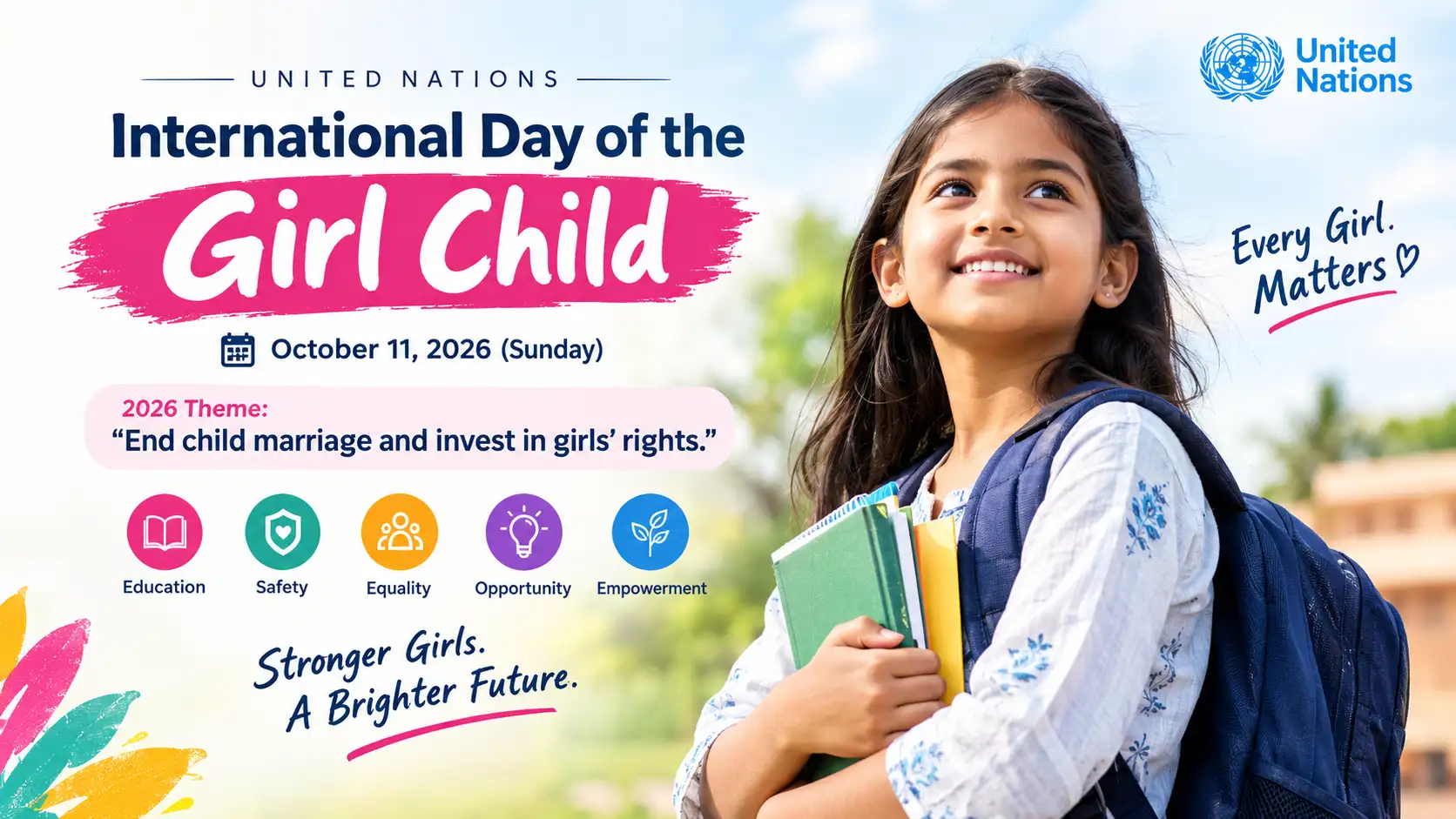
What Is International Day of the Girl Child?
International Day of the Girl Child is observed every year on October 11 to recognize girls' rights, amplify their voices, and draw attention to the challenges that girls face around the world. The observance focuses on creating a future where every girl can access education, live safely, make informed choices, and reach her full potential.
In 2026, International Day of the Girl Child falls on Sunday, October 11. The United Nations has chosen the theme “End child marriage and invest in girls’ rights.” The theme highlights the importance of protecting girls from child marriage while investing in education, health, safety, social protection, and opportunities that allow girls to shape their own futures.
Although the day is global, its message is relevant everywhere, including the United States. Families, schools, communities, nonprofits, businesses, and policymakers can use the occasion to support girls' education, leadership, digital access, safety, and equal opportunities.
When Is International Day of the Girl Child 2026?
International Day of the Girl Child 2026 is Sunday, October 11, 2026.
| Event | Details |
|---|---|
| Observance | International Day of the Girl Child |
| Date | October 11, 2026 |
| Day | Sunday |
| 2026 Theme | End child marriage and invest in girls’ rights |
| Established by | United Nations General Assembly |
What Is the Theme of International Day of the Girl Child 2026?
The official International Day of the Girl Child 2026 theme is “End child marriage and invest in girls’ rights.”
The theme calls attention to the continuing impact of child marriage and the need for stronger investment in girls. According to the United Nations, more than 12 million girls are married before reaching adulthood each year, making child marriage one of the major barriers to girls' education, safety, health, and future opportunities.
The message is not only about preventing child marriage. It is also about creating the conditions in which girls can thrive. This includes keeping girls in school, improving access to health and protection services, challenging harmful social norms, strengthening legal protections, and supporting girls' participation in decisions that affect their lives.
Why Is International Day of the Girl Child Important?
Girls around the world can face barriers that affect their education, health, safety, economic opportunities, and ability to make decisions about their own lives. These challenges can become even more serious during poverty, conflict, displacement, humanitarian emergencies, and other crises.
International Day of the Girl Child creates an opportunity to move the conversation beyond awareness and toward action. It reminds governments, communities, families, educators, and organizations that supporting girls is essential to building healthier and more equal societies.
When girls have access to quality education and opportunities, they can become future professionals, entrepreneurs, scientists, educators, community leaders, and policymakers. Supporting girls therefore benefits not only individual girls but also families, communities, and economies.
History of International Day of the Girl Child
The United Nations General Assembly officially declared October 11 as the International Day of the Girl Child through Resolution 66/170 on December 19, 2011.
The first official observance took place in 2012. The day was created to recognize girls' rights and highlight the unique challenges girls face around the world.
The observance also builds on the international commitment to gender equality and the rights of children. The 1995 Beijing Declaration and Platform for Action was an important milestone because it specifically addressed girls' rights and identified areas where greater action was needed.
Since its establishment, International Day of the Girl Child has become an annual opportunity to celebrate girls' achievements while encouraging governments and communities to address the barriers that prevent girls from reaching their potential.
What Challenges Do Girls Face?
The challenges facing girls vary by country, community, age, and circumstances. Some girls experience several barriers at the same time. Major issues highlighted by international organizations include:
- Child marriage: Early marriage can interrupt education and limit a girl's ability to make decisions about her future.
- Limited access to education: Poverty, conflict, discrimination, and social expectations can prevent girls from attending or completing school.
- Gender-based violence: Girls can experience different forms of violence at home, at school, online, or in their communities.
- Poverty and economic inequality: Financial hardship can restrict access to education, healthcare, technology, and other opportunities.
- Health challenges: Adolescent girls may face barriers to essential healthcare and accurate information about their health and well-being.
- Digital inequality: Limited access to technology and digital skills can reduce girls' educational and career opportunities.
- Discrimination: Gender stereotypes can influence how girls are treated and what opportunities they are encouraged to pursue.
- Conflict and displacement: Emergencies can increase girls' exposure to violence, child marriage, interrupted education, and other risks.
How Does Education Empower Girls?
Education is one of the most important ways to expand opportunities for girls. A quality education can help girls develop knowledge, confidence, practical skills, and the ability to participate more fully in society.
Keeping girls in school can also help protect them from harmful practices and improve their future economic opportunities. Education gives girls more choices about their careers and helps them participate in decisions affecting themselves, their families, and their communities.
Supporting girls' education means more than simply enrolling students in school. It also means creating safe learning environments, improving educational quality, reducing financial barriers, and ensuring that girls can continue learning during emergencies and difficult circumstances.
How Can We Support Girls on International Day of the Girl Child?
You do not need to organize a large event to make International Day of the Girl Child meaningful. Individuals and organizations can take practical steps to support girls and promote their rights.
1. Support Girls' Education
Donate to organizations that help girls access education, provide school supplies, offer scholarships, or create safe learning environments. Schools and community groups can also organize educational activities focused on girls' rights and leadership.
2. Listen to Girls' Voices
Girls should have opportunities to express their ideas and participate in decisions that affect them. Parents, teachers, community leaders, and organizations can create safe spaces where girls can speak openly and be taken seriously.
3. Encourage Leadership
Encourage girls to participate in student organizations, community projects, sports, science, technology, arts, entrepreneurship, and other activities. Leadership opportunities can help young people build confidence and practical skills.
4. Promote Digital Skills
Technology can open doors to education, communication, creativity, and employment. Helping girls develop digital literacy and access to technology can reduce barriers to future opportunities.
5. Challenge Harmful Stereotypes
Small changes in everyday conversations can make a difference. Encourage girls to explore interests and careers without limiting them based on traditional gender stereotypes.
6. Learn About Child Marriage
Use International Day of the Girl Child as an opportunity to learn about the causes and consequences of child marriage and support evidence-based efforts that protect children's rights.
7. Share Reliable Information
Schools, businesses, nonprofits, and individuals can share educational resources about girls' rights through social media, community events, newsletters, and classroom activities.
How Can Schools Celebrate International Day of the Girl Child?
Schools can turn October 11 into an opportunity for meaningful learning and student participation. Activities can be adapted for different ages and educational settings.
- Organize a girls' leadership discussion.
- Invite women professionals to speak about their careers.
- Hold an essay, speech, or poster competition about girls' rights.
- Discuss the importance of education and equal opportunities.
- Teach students about the history of International Day of the Girl Child.
- Create a student-led campaign supporting girls' education.
- Host workshops about digital literacy, STEM, entrepreneurship, or leadership.
International Day of the Girl Child in the United States
In the United States, International Day of the Girl Child can be observed through schools, universities, nonprofits, youth organizations, community groups, and social media campaigns. Activities may focus on girls' education, STEM participation, leadership, digital skills, mental well-being, safety, and equal opportunities.
Organizations can also use the day to highlight programs that support girls from underserved communities and create opportunities for young people to participate in leadership and community service.
For families, the day can be as simple as having a conversation with children about equality, encouraging girls to pursue their interests, supporting educational opportunities, or learning about organizations working to protect children's rights.
International Day of the Girl Child Facts
- International Day of the Girl Child is observed every year on October 11.
- The United Nations General Assembly established the observance through Resolution 66/170 in 2011.
- The first official observance took place in 2012.
- The day focuses on girls' rights, empowerment, and the challenges girls face worldwide.
- The 2026 theme is “End child marriage and invest in girls’ rights.”
- More than 12 million girls are married before adulthood each year, according to the United Nations.
- UNICEF estimates that about one in five girls worldwide are married before age 18.
- Investing in girls' education, protection, health, and leadership can help create stronger and more resilient communities.
Why Investing in Girls Benefits Everyone
Supporting girls is not only a matter of individual rights. It is also an investment in the future. When girls have opportunities to learn, develop skills, stay healthy, and participate in society, they can contribute to their families, communities, workplaces, and economies.
That is why International Day of the Girl Child is about more than celebrating girls for one day. It is a reminder that long-term progress requires sustained investment and action.
Ending harmful practices, improving access to education, strengthening protections, and giving girls meaningful opportunities to lead can help create a future in which every girl has the freedom to decide what she wants her life to become.
How to Observe International Day of the Girl Child in 2026
On October 11, 2026, consider taking one practical action to support girls. You could donate to a trusted organization, mentor a young person, support girls' education, volunteer in your community, share reliable information, or simply listen to the ideas and experiences of girls around you.
The most meaningful way to recognize this day is to turn awareness into action. Every girl deserves the opportunity to learn, grow, stay safe, make choices about her future, and have her voice heard.
Frequently Asked Questions About International Day of the Girl Child
When is International Day of the Girl Child?
International Day of the Girl Child is observed every year on October 11. In 2026, it falls on Sunday, October 11.
What is the theme of International Day of the Girl Child 2026?
The 2026 theme is “End child marriage and invest in girls’ rights.” The theme calls for stronger action to prevent child marriage and greater investment in girls' education, safety, health, rights, and opportunities.
Why do we celebrate International Day of the Girl Child?
The day raises awareness about girls' rights and the unique challenges girls face while promoting their empowerment, education, safety, equality, and participation in society.
Who established International Day of the Girl Child?
The United Nations General Assembly established International Day of the Girl Child through Resolution 66/170 on December 19, 2011.
What can I do on International Day of the Girl Child?
You can support girls' education, donate to trusted organizations, mentor young people, promote equal opportunities, challenge harmful stereotypes, share reliable information, or participate in a local awareness event.
Is International Day of the Girl Child only celebrated in the United States?
No. International Day of the Girl Child is a global United Nations observance recognized around the world. Individuals, schools, governments, nonprofits, and communities can participate regardless of location.
A Future Where Every Girl Can Thrive
International Day of the Girl Child reminds us that girls should not have to choose between safety, education, opportunity, and their right to shape their own future. The challenges are significant, but progress is possible when communities and institutions invest in girls and protect their rights.
On October 11, let the message be more than a social media post or one-day event. Support girls' voices, education, safety, leadership, and freedom to make choices about their lives. When girls are given the opportunity to thrive, they can help create a stronger and more equitable future for everyone.