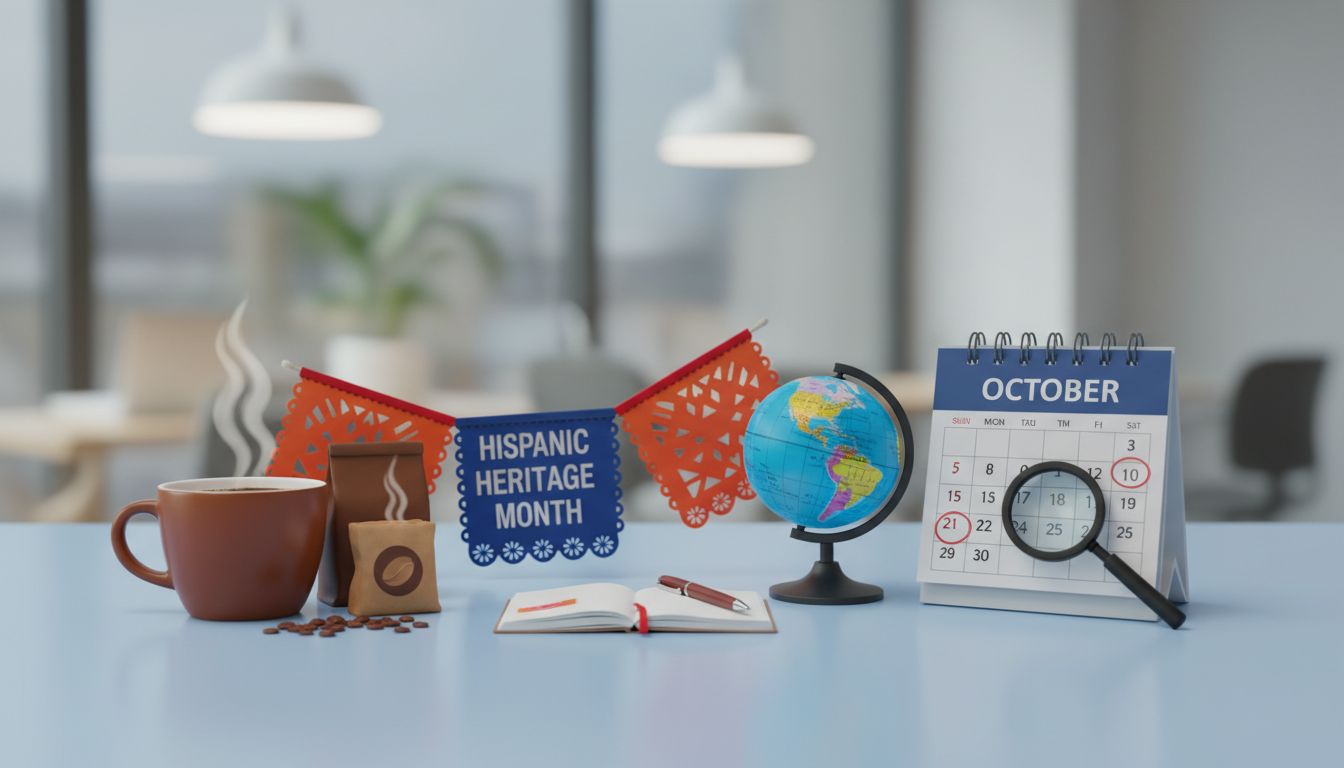
Small businesses do not need a huge holiday budget to make seasonal marketing useful. Awareness day marketing works best when a short, timely moment such as National Coffee Day becomes an entry point to a practical offer, while a longer observance such as Hispanic Heritage Month supports relationship-building, education, and community visibility.
This month offers both. National Coffee Day on September 29 can create immediate traffic and email activity, while Hispanic Heritage Month, observed from September 15 through October 15, gives businesses time to tell thoughtful stories, feature partners, and serve customers in more relevant ways. The strongest plan is not to post for the sake of a calendar date; it is to connect each activity to a customer need, a credible local relationship, and a measurable business goal.
Awareness day marketing: the direct answer for small businesses
Use National Coffee Day for a focused, conversion-oriented promotion and Hispanic Heritage Month for sustained community-led storytelling. Choose one business goal for each, create an offer or useful piece of content that fits that goal, promote it through the channels customers already use, and measure sales, leads, sign-ups, or partner referrals rather than likes alone.
The two observances operate on different timelines. A one-day coffee event is well suited to a clear call to action: visit before a certain time, claim a bundle, try a limited menu item, or join a subscription. Hispanic Heritage Month is better treated as a window for a series of actions rather than a single promotional post.
That distinction protects a small team from a common mistake: trying to build a month-long campaign with daily content when the business only has capacity for a few high-quality touchpoints. A restaurant, retailer, service provider, or B2B company can create a credible campaign with one partner spotlight, one customer-facing improvement, one event or offer, and a simple recap.
- Use National Coffee Day to pursue: same-day revenue, morning foot traffic, product trials, email or loyalty enrollments, and social content with a direct next step.
- Use Hispanic Heritage Month to pursue: local partnerships, trusted bilingual communication, educational content, supplier or founder stories, and longer-term customer relationships.
- Use both together only when the connection is real: for example, a coffee shop working with a Hispanic-owned roaster, artist, baker, or community organization.
Starting with the goal makes creative choices easier. If the need is to fill quiet morning hours, an afternoon giveaway is poorly aligned even if it gets attention. If the goal is to deepen a community relationship, a generic discount with heritage-themed graphics is a weak substitute for collaboration and appropriate credit.
Build a National Coffee Day campaign around real coffee routines
National Coffee Day lands on September 29, but its value is not limited to 24 hours. Coffee is part of an established daily pattern for many Americans. The National Coffee Association’s 2026 National Coffee Data Trends report says 66% of American adults drank coffee in the past day, 85% of those past-day drinkers had coffee at breakfast, and 82% drank coffee at home. Coffee drinkers average nearly three cups per day.
Those habits point to a practical lesson: make the promotion fit the moment customers already associate with coffee. A breakfast bundle, a scheduled refill reminder, a morning-only service special, or a take-home product can be more useful than a complicated all-day deal.
Choose one offer customers can understand quickly
A good National Coffee Day offer has a clear audience, a simple benefit, and a limit that the business can actually fulfill. The limit can be time, inventory, channel, or customer segment. It does not have to be a deep discount.
- Identify the operational goal. Examples include lifting 7,10 a.m. visits, selling more beans, introducing a loyalty program, or generating appointments for a nearby service business.
- Match the offer to the goal. A café might bundle coffee with breakfast. A bookstore might offer a coffee-and-reading event with a local café. A salon might provide coffee during morning appointments rather than discounting a service.
- Set a guardrail. State a time window, quantity, minimum purchase, reservation requirement, or while-supplies-last limit. This helps protect margin and staff capacity.
- Create one frictionless action. Use a QR code, a landing page, a loyalty sign-up link, a booking link, or a verbal code at checkout.
- Promote before the date and follow up after it. Announce the offer early enough for customers to plan, then use the event to invite a second visit or subscription.
Not every business needs to sell coffee to participate. An office supply store can offer coffee for early shoppers. A coworking space can hold a morning drop-in. A consultant can share a useful “coffee break” resource or host short appointments. The promotion should be adjacent to the business, not a forced attempt to imitate a café.
Test premium and cold-coffee ideas without overbuilding the menu
Specialty coffee may justify a limited premium offer for businesses that already have the product quality and staff training to support it. The National Coffee Association’s 2026 Specialty Coffee Report says 46% of American adults had specialty coffee in the past day, a 14-year high, compared with 42% who had traditional coffee.
That does not mean every operator should add elaborate drinks. It means there may be an audience for a well-executed, limited product with a clear story. Test one item, forecast the ingredients, train staff on the recipe, and decide in advance what result would warrant keeping it after the campaign.
Cold coffee is another useful test area. The National Coffee Association reports sharply rising cold brew popularity and broader consumer movement toward cold coffee formats. For a visual channel such as Instagram or short-form video, an iced beverage can be easier to show than a standard hot cup. Still, a small business should consider season, local weather, equipment, prep time, and waste before committing to a large production run.
Adapt the coffee message to your market
Local context matters. In the National Coffee Association’s 2026 spring media highlights, past-day coffee consumption was highest in the Northeast at 75%, compared with 68% in the West, 66% in the South, and 57% in the Midwest. A Northeast operator may find coffee is an especially natural audience hook, but businesses in every region should check their own sales patterns rather than assume national data will predict a single neighborhood.
Coffee remains economically meaningful beyond the counter. The National Coffee Association reports that coffee’s total U.S. economic impact was $343.2 billion in 2022. The organization also notes that the industry supports more than 2.2 million U.S. jobs and more than $100 billion in annual wages. These facts can support a broader supplier, worker, or origin story when the business has direct knowledge of the people and products it features.
Use Hispanic Heritage Month for authentic local engagement
Hispanic Heritage Month runs from September 15 through October 15. Official materials describe it as a time to recognize the histories, cultures, and contributions of Americans with roots in Spain, Mexico, Central America, South America, and the Spanish-speaking Caribbean.
For a small business, the best starting point is not “What themed product can we sell?” It is “What relationship, expertise, or service can we elevate responsibly?” The answer may be a local business partnership, a paid artist collaboration, bilingual customer information, a supplier feature, or a learning event tied to a credible community organization.
The period also contains meaningful independence anniversaries: September 15 is associated with Costa Rica, El Salvador, Guatemala, Honduras, and Nicaragua; Mexico’s independence day is September 16; and Chile’s is September 18. These dates can inform programming, but they are not interchangeable. Avoid treating diverse national traditions as one uniform culture or presenting a country’s history without input from people with relevant knowledge.
Start with a relationship map, not a content calendar
Before scheduling posts, list the people and organizations already connected to the business. This makes outreach more specific and reduces the risk of superficial messaging.
- Hispanic-owned businesses that may be open to a reciprocal referral, joint event, or co-marketing effort.
- Local artists, musicians, educators, authors, chefs, or makers whose work can be fairly compensated and credited.
- Community organizations, schools, libraries, chambers, and cultural groups with established programming or resource needs.
- Current employees, customers, and suppliers who may wish to contribute ideas voluntarily, without pressure to represent an entire community.
- Customer-service touchpoints where Spanish-language information would make a real difference, such as booking, ordering, pickup, or product instructions.
Then decide what the business can contribute. A venue may offer space. A retailer may feature and pay local vendors. A professional services firm may share accessible educational resources. A café may create a partner-led tasting or discussion. The collaboration should have a benefit for the partner that is as concrete as the benefit for the business.
Make bilingual communication useful, not decorative
There is a practical basis for considering Spanish-language communication. The Census Bureau’s Hispanic Heritage Month fun facts page says roughly 14% of people age 5 and older in the United States speak Spanish. That does not mean a business should automatically translate every asset, particularly if it cannot review the wording or support customers in the language used.
Instead, prioritize high-impact moments. Translate the event details, ordering instructions, appointment reminders, returns information, or core promotional email when those are relevant to the audience. Have a qualified reviewer check the wording. Plain, accurate Spanish is more valuable than a flashy bilingual line followed by an English-only checkout, phone line, or policy page.
Population scale also makes localized outreach worth considering. Census Bureau 2026 materials put the Hispanic population at 70.1 million and provide data across topics including families, housing, language, education, jobs, income, and health. National scale is not a substitute for local insight, however. Review customer feedback, neighborhood demographics where appropriate, and conversations with local partners before selecting language, channels, and programming.
Plan Hispanic Heritage Month content with context and credit
Content performs better when it gives the audience something to learn, do, or support. During a cultural observance, that standard is also a trust issue. A business should be able to explain why it is telling a story, who benefits, and where the information came from.
The Library of Congress offers a credible starting point for educational planning. Its 2026 Hispanic Heritage Month programming includes collections, music, and cultural traditions during the September 15,October 15 observance. The Census Bureau also released 2026 Hispanic Heritage Month facts in August, and the Library of Congress published new resources in September 2026. These materials can help a business identify accurate themes for posts, staff learning, reading lists, or event ideas.
Turn a source into a small series
Rather than publishing one broad celebratory message, build a short sequence around a verified source and a local connection. A four-part series is enough for many small teams:
- Introduce the focus. Explain the event, collaboration, resource, or service update and state what customers can expect.
- Feature the contributor. Let the partner, artist, owner, educator, or organization describe their work in their own words. Confirm approval before publishing.
- Offer value. Share a useful resource, learning opportunity, product demonstration, or local event detail with clear attribution.
- Close the loop. Report what happened, thank contributors, encourage continued support, and state the next concrete action.
This approach is workable for businesses that do not have a large creative department. It also gives the partner more than a passing mention. Ask how they want their name, business, work, links, and social accounts presented, and do not assume that a tag is adequate compensation for commissioned work.
Respect the boundaries of cultural marketing
Avoid using heritage primarily as packaging, costumes, stereotypes, or a one-month visual theme. Do not claim an “authentic” experience without a legitimate basis. Do not use flags, food, language, or traditions as shorthand for an entire population. These choices can undermine trust with the very customers a campaign hopes to reach.
A better alternative is specific attribution: name the collaborator, identify the particular tradition or region only when it is relevant and confirmed, and describe the business relationship plainly. If there is no real relationship to highlight, support a local program, share an educational resource, or improve a customer experience instead of manufacturing a cultural campaign.
Connect National Coffee Day and Hispanic Heritage Month without forcing the link
These observances can share a calendar without sharing a single message. National Coffee Day is an immediate commercial moment; Hispanic Heritage Month is a broader cultural observance. Combining them makes sense only when the business has a genuine coffee, supplier, maker, culinary, or community relationship that supports the story.
For example, a coffee business might work with a Hispanic-owned bakery on a paid breakfast bundle, feature an origin-focused coffee with accurate supplier information, or host an educational event led by a paid local collaborator. A bookstore could pair a coffee service with a reading or author event. A retailer could feature coffee-related merchandise made by a local partner. The product is not the point by itself; the partner’s work and the customer value need to be clear.
Three campaign models that stay grounded
- The partner bundle: Create a limited breakfast, gift, or service package with a local Hispanic-owned business. Agree on pricing, inventory, promotion, customer data access, and how each party will be credited before launch.
- The supplier story: Share factual information about a coffee product, the producer or supplier relationship, and why the business selected it. Use only details that the supplier has confirmed, and avoid romanticizing origin or labor.
- The community event: Host a tasting, workshop, performance, pop-up, or discussion with a compensated contributor. Keep the event scope manageable and give attendees a clear reason to return or support the partner afterward.
There is room for B2B businesses, too. Census Bureau materials note that 10.0% of Hispanic workers were self-employed in 2023, compared with 9.6% of non-Hispanic workers. A bank, accountant, agency, software provider, insurer, or legal professional could use the month to offer an accessible resource session for local entrepreneurs, co-hosted with a trusted organization. The most credible format is educational and specific, not a generic sales pitch aimed at a demographic category.
Be transparent about commercial intent. If the campaign includes a sale, say so. If proceeds support an organization, define the arrangement precisely before promoting it. If the purpose is simply to spotlight a partner, do not imply a donation or community benefit that does not exist.
Create a September-to-October promotional calendar your team can run
A concise campaign calendar prevents last-minute posting and allows the business to coordinate inventory, staffing, email, social media, signage, and partners. It is especially useful here because the observances have different endpoints: National Coffee Day peaks on September 29, while Hispanic Heritage Month continues through October 15.
Early seasonal activity can also be timely. Sprout Social’s 2025 Pulse Survey analysis says 44% of social users are more likely to buy from brands that launch fall and winter marketing early. That does not require a long, aggressive campaign. It supports giving customers enough notice to see, understand, and act on an offer before the date passes.
A lean four-phase schedule
- Prepare: confirm partners, permissions, inventory, staff responsibilities, translations, offer terms, and tracking links. Draft all essential customer-facing copy before the promotional rush.
- Launch the heritage-month initiative: share the first partner or resource story, update relevant signage or service information, and invite customers to an event or useful action.
- Build toward September 29: introduce the coffee offer through email, social posts, in-store prompts, and local partner channels. Explain the time window and any redemption conditions clearly.
- Extend through October 15: recap National Coffee Day results, continue approved partner storytelling, complete events or promotions, and thank participants without treating the end date as the end of the relationship.
Use the channels that match the offer. Email is often effective for a loyalty reward, pre-order, or appointment reminder. In-store signage helps regular visitors. Short video can show a cold beverage or introduce a collaborator. A landing page is useful when an event requires RSVP information or when the business needs to capture leads. A local partner’s newsletter may be more valuable than a broad paid campaign if the audience is well aligned.
Do not create a new channel merely for this campaign. Consistency on one or two channels customers already recognize is usually more manageable than spreading a small team across every platform.
Measure campaign results beyond social engagement
Likes and views can indicate that people noticed a post, but they do not tell a small business whether the campaign improved revenue, customer retention, community relationships, or service. Decide what success means before launch and record a baseline where possible.
For National Coffee Day, the simplest measures may be redemptions, units sold, average order value, morning transactions, loyalty enrollments, or repeat purchases after the event. For Hispanic Heritage Month, useful measures can include event registrations and attendance, partner referrals, bilingual page visits, inquiries, customer feedback, local press interest, or follow-up opportunities for the partner.
Keep tracking simple enough to use
- Create a distinct point-of-sale button, promotion code, QR code, or landing page for the coffee offer.
- Ask event registrants how they heard about it, using a short list that includes each partner channel.
- Track the cost of discounts, products, paid collaborators, printing, staff time, and advertising alongside revenue.
- Save customer comments and staff observations, especially around demand, confusion, translation quality, and operational bottlenecks.
- Schedule a short debrief with partners and staff after the campaign, then share relevant results with collaborators.
One campaign does not need to deliver every outcome. A coffee offer may be profitable but add few email subscribers. A community event may produce modest immediate sales while strengthening a relationship worth continuing. Review results against the original goal rather than declaring the campaign a success or failure based solely on reach.
Also consider what should continue after the observance. A well-received breakfast bundle might become a recurring weekday option. A bilingual service improvement should remain if the business can maintain it. A partner relationship should not disappear after October 15 simply because the campaign calendar has moved on.
A practical checklist before you publish or launch
Good intentions do not replace execution. Before releasing any National Coffee Day or Hispanic Heritage Month materials, use this final check to protect customer experience, partner trust, and operational capacity.
- Can a customer understand the offer, price, date, time, and redemption process in a few seconds?
- Does the campaign have one primary goal and a way to track it?
- Can staff fulfill the offer without creating unacceptable delays, shortages, or confusion?
- Have collaborators approved how their names, work, images, and stories will be used?
- Are partners paid, credited, and linked in the way you agreed?
- Are any cultural claims, historical references, and supplier details accurate and properly attributed?
- Is Spanish-language content reviewed and matched by a realistic customer-support plan?
- Does the business have a follow-up message for customers, staff, and partners?
The purpose of this checklist is not to make seasonal marketing slow or overly formal. It is to prevent the avoidable errors that can turn a promising local idea into a difficult service day or an untrustworthy message.
National Coffee Day gives small businesses a concrete reason to activate a familiar daily routine on September 29. Hispanic Heritage Month offers a longer period, from September 15 to October 15, to build visibility through accurate storytelling, useful bilingual communication, paid collaborations, and community partnerships. Treat the first as a focused sales opportunity and the second as a relationship opportunity, then connect them only when the connection is genuine.
Choose one attainable offer, one credible partner or resource, and a few measures that matter to the business. That disciplined approach turns awareness day marketing from a rush to post into a practical way to earn attention, serve customers, and create work worth continuing after the dates have passed.